
Glass is the defining material of contemporary architecture, being transparent, elegant, and endlessly versatile. It opens spaces, invites light, and fosters connection. Yet, as interiors have evolved to embrace openness, new challenges have emerged.
Read MoreWhy Reeded Film Is the Smarter Alternative to Reeded Glass /

The Look You Want, the Flexibility You Need
Reeded glass film isn’t just a design trend — it’s a modern solution for interiors that demand both visual impact and functional adaptability. Whether you’re upgrading a single conference room or reimagining an entire building, Chroma Reeded Films deliver refined texture, efficient performance, and long-term value — without the complexity or cost of custom glass.
Setting the Standard in Architectural Surface Innovation
With decades of expertise in architectural films, APG Design Studio has become a trusted partner for designers, architects, and property teams across the U.S. Our Chroma Collection offers one of the largest selections of reeded films available today — engineered for high-end interiors and dynamic commercial environments.
📞 Interested in seeing the difference? Contact us to request samples or schedule a consultation.
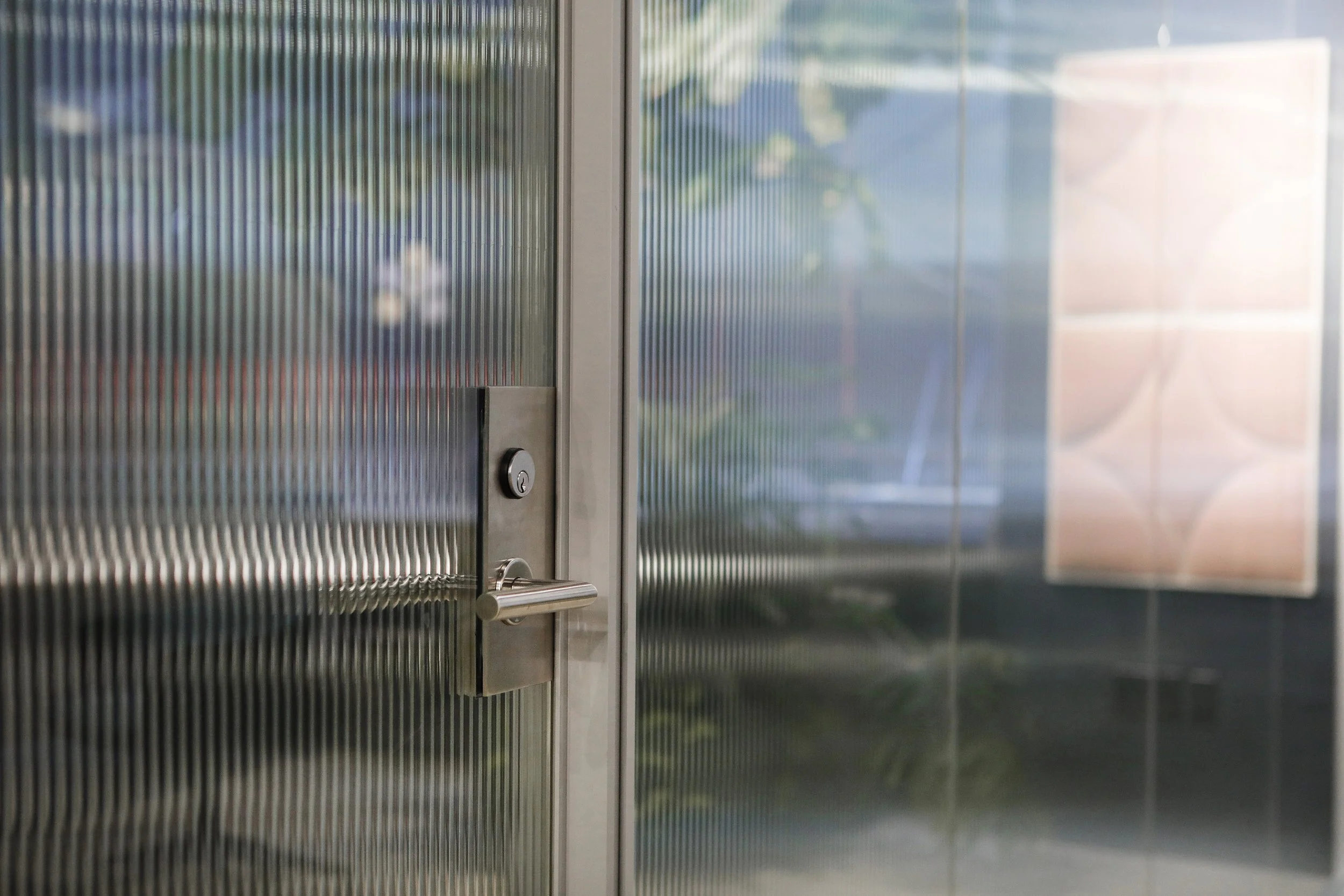
1. Premium Aesthetic at a Lower Cost
Custom fluted glass panels often require:
Specialty fabrication
Framing or structural support
Complex transport and handling
Multi-trade professional installation
In contrast, Chroma Reeded Films replicate the dimensional look of fluted glass at approximately 20–40% of the total cost, depending on scope and finish. For large-scale or budget-conscious projects, this means substantial savings without compromising design integrity.
💡 Search tip: Try “reeded glass alternatives” or “budget fluted glass solutions.”
2. Flexible, Removable, and Adaptable
Unlike permanent glass installations, reeded film can be installed, removed, or replaced without demolition or damage. This makes it ideal for:
Temporary office builds or phased renovations
Tenant improvements (TIs) in commercial spaces
Design refreshes for property staging or leasing
🛠️ Applies directly to existing glass walls, doors, or dividers — no framing, no construction, no downtime.
3. Fast, Non-Invasive Installation
Film installation requires:
No drilling
No structural modification
No extended closures
Most projects can be completed in a single day, even in active office environments or occupied buildings — making Chroma Reeded Film a smart choice for off-hours or weekend upgrades.
🕒 Typical installation time: 1–4 hours per area, depending on scale and accessibility.
4. Sustainable and Less Disruptive
Because reeded film applies directly to existing glass, there’s no need for demolition or glass replacement, which reduces waste, energy use, and landfill impact. It’s an eco-conscious solution that supports LEED and sustainability goals, helping projects meet green building criteria while minimizing disruption to operations.
By contrast, replacing glass panels requires:
Manufacturing new glass
Removing and disposing of old panels
Increased transportation and on-site labor
Greater material waste and carbon footprint
Reeded film eliminates all of that — offering a clean, efficient path to a refreshed, contemporary aesthetic.
5. Color Customization Without Light Loss
While fluted glass is generally limited to clear or frosted finishes, Chroma Reeded Films are available in a range of refined tones, including:
Clear, White, Black, Bronze, Blue, and Custom Color Match.
These hues allow for brand-aligned design and subtle mood customization — all while maintaining natural daylight and visibility. Perfect for spaces where brightness and openness are key.
🎨 Looking to match your interior palette? Custom color matching is available upon request.
6. Maintenance, Safety, and Durability
Reeded film offers the look of textured glass with simplified maintenance and added safety benefits.
Easy to clean with standard non-abrasive cleaners
Scratch-resistant, durable surface coatings
Safer in high-traffic environments (no heavy glass replacement risk)
Can be replaced quickly if damaged — no glass removal required
For facility teams and property managers, this means reduced maintenance costs and less operational downtime over the life of the installation.
7. The Largest Selection of Reeded Films in the U.S.
The Chroma Reeded Film Collection by APG includes:
15+ distinct reeded and fluted patterns
Multiple flute widths and depths
Gloss, matte, and gradient finishes
Clear, tinted, and layered options
APG also supports custom pattern development for brand-specific or one-of-a-kind design projects.
Why Choose Film Over Glass?
If you can achieve the same elevated aesthetic at a fraction of the cost, time, and disruption — why choose glass? Chroma Reeded Film delivers the same texture, light play, and sophistication as reeded or fluted glass, but with:
✅ Lower material and labor costs
✅ Faster turnaround
✅ Less waste and environmental impact
✅ Easier maintenance and updates
✅ Complete creative freedom
Elevate Your Glass with Chroma
Whether your goal is privacy, light control, or design distinction, Chroma Reeded Film provides the perfect blend of elegance, efficiency, and adaptability.
👉 Ready to explore the collection? Contact APG Design Studio
Key Technical Advantages
Feature. Description
Retrofit-friendly. Applies to existing glass—no structural changes needed
Lightweight. No added load to partitions or glass walls
Durable. Scratch-resistant and easy to clean (standard maintenance protocols)
Code-Compatible. Meets common interior building standards (spec sheet available upon request)
Privacy on Demand Provides visual separation without total opacity
Quick Cost Comparison (Estimates)
Material Approx. Installed Cost (per sq. ft.)
Fluted/Reeded Glass. $80–$140+ (includes material, fabrication, install)
Reeded Film (Chroma). $15–$35 (material + install depending on project size/scope)
🔍 Smarter by Design
Reeded film offers the look of glass with none of the logistical complexity of construction. For interior designers, architects, and property managers seeking efficient, stylish glass upgrades, Chroma Reeded Films offer a clear path to elegant, functional results—at scale and on budget.
Whether you're outfitting a Class-A lobby, redesigning amenity areas, or rebranding commercial interiors, Chroma Reeded films help you do more—with less.
📞 Let’s Talk
Need specs, samples, or a custom quote? Contact us today to get started.
Would you like a downloadable spec sheet template or product comparison chart to go with this version for your site or sales team?
Environmental Graphics That Transform Spaces with Purpose and Impact /
Environmental graphics are more than just decoration—they're a strategic design solution that elevates both the visual appeal and functional experience of a space. From corporate interiors and retail environments to healthcare facilities and residential amenity spaces, these large-scale visual elements turn ordinary surfaces into immersive, branded experiences.
Read MoreBeyond the Surface: The Power of Custom Glass Films, Wall Graphics & Environmental Graphics /
In today’s architecture and branding environments, walls and glass aren’t just surfaces — they’re canvases waiting to tell a story, reinforce identity, and elevate experience. At APG Design Studio, we don’t see glass, drywall, or partitions as limits. We see opportunity.
We combine creative vision, state-of-the-art print technology (SwissQ‑powered), rigorous quality control, and expert installation know-how to bring environments to life. And we do it not only for end clients but for industry partners — designers, general contractors, signage firms — who demand precision, aesthetics, and reliability.
The Magic Under Glass: Custom Glass Films
Glass is unique: it transmits, reflects, divides — but often it’s under-utilized. With custom glass films, we turn transparent barriers into expressive elements. Frosted or sandblasted effects, geometric patterns, subtle textures, or bold graphics — each can be tailored exactly to a project’s vision.
Privacy + translucency balance: You can retain daylight while controlling sightlines.
Visual delight: Intricate patterns and artwork can be embedded directly onto the film.
Functional overlays: Films can carry branding, signage, graphics, or even wayfinding cues.
At APG, the design possibilities are unlimited. Our design team works with clients from the concept stage, or steps in to refine existing schemes. Because we own the workflow — from design to print to installation — we manage consistency in resolution, color fidelity, and alignment across glass panels.
Walls That Speak: Wall Graphics & Environmental Graphics
Walls are a brand’s backdrop — or its megaphone.
Wall graphics allow immersive imagery, accent zones, murals, or messaging. They transform blank planes into storytelling canvases.
Environmental graphics go deeper: integrating signage, wayfinding, visual identity, even signage hierarchies into the architecture itself. These are the graphics that guide, orient, and connect people with space.
An environmental graphics program is never merely decoration — it must function, age well, harmonize with interiors, and reinforce purpose.
SwissQ Print — The Technology Powering Precision
A great design deserves a great production backbone. That’s where SwissQ print comes in. We harness SwissQ-powered digital printing — known for high resolution, consistency, and color depth — to ensure that even the finest details reproduce cleanly on film and substrate.
Because APG controls the entire pipeline:
Color management & proofing — we calibrate from design to output, reducing surprises.
High-resolution workflows — gradients, fine lines, subtle textures — all are preserved.
Robust materials & finishing — lamination, protective coatings, and substrate prep help ensure longevity in real-world use.
This print capability enables us to push creative boundaries: from subtle gradations on glass films to massive wall graphics with rich photographic detail.
Attention to Detail & Quality Control
In a field where a slight miscut, seam misalignment, or edge lift can ruin the illusion, details matter. At APG:
Every design passes through mockups and digital proofs.
Seams and joins are planned strategically (horizontal or vertical, depending on orientation).
Material tolerances, adhesives, substrate curvature — all are accounted for.
Before installation, we conduct pre-checks on substrate condition, alignment, ambient temperature/humidity, dust control, and masking.
During installation, low-angle lighting and fine adjustments guide final placement.
We don’t just finish a job — we inspect it, adjust it, fine-tune it, and guarantee it meets our standards.
Installation Expertise: From Vision to Reality
Installation is not just “sticking film on glass or wall.” It’s a craft. We deploy:
Experienced, trained crews who know the nuances of pressure-sensitive adhesives, heat-forming, edge sealing, and stress relief.
Tools and best practices — edge sealing, gradual heating, overlapping techniques, clean squeegee paths.
Sequenced installation planning to minimize disruption in occupied spaces.
Because we’re both designers and installers, we think ahead: we build templates, pre-cut panels, and simulate constraints so that on-site surprises are minimized.
Serving Industry Partners: Trade & Collaborative Workflows
One of the strengths of APG is how well we collaborate with industry partners — architects, designers, signage firms, GCs, window-film companies:
We design and print for trade clients, offering trade-level pricing, flexibility, and collaboration. APG Design Studio
We can integrate into broader execution chains: you bring us the specs; we deliver install-ready panels.
We work with partner firms to co-manage timelines, margins, design handoffs, and installation coordination.
By being a responsive, reliable backend for trade professionals, we amplify their capacity and trust in the final outcome.
Why Choose APG for Your Next Graphic/Film Project
Creative capability — We aren’t just printers; we are designers who speak the language of form, space, brand, and experience.
Technical strength — Equipped with SwissQ-powered printing, substrate expertise, lamination, and coatings.
Detail & QC — Every job undergoes rigorous inspection and alignment checks before and after installation.
Installation mastery — Our installation crews understand film behavior, edge conditions, and architectural constraints.
Partner-ready — We open our services to industry clients, designing and printing under trade-level frameworks.
Whether the task is a frosted-glass privacy film, a full-height environmental wayfinding program, or a seamless wall mural campaign — we approach it as a unified design‑print-install challenge, ensuring that your aesthetic, functional, and brand objectives align beautifully.
Let’s turn your walls and glass into narratives, not just surfaces. Contact us, and let’s begin something creative — from concept to finish.
Benefits of Architectural Finish Films For the Hospitality Industry /
In the hospitality industry, where first impressions and guest experience define success, architectural finish films have become a smart, sustainable alternative to traditional renovations. At APG Design Studio, we work with industry-leading brands like 3M™ Di-Noc™, Reatec, and Belbien to help hotels, resorts, and restaurants transform interior environments without costly or disruptive construction.
Read MoreHow Sun Control Films Reduce Building Energy Use — Data & Case Studies /
Understanding how modern buildings can cut soaring energy bills and maintain comfortable indoor climates has become crucial. Sun Control Window Films offer a proven solution by filtering infrared radiation and reducing solar heat gain without compromising natural light. Through targeted SHGC reduction with window film, facility managers witness dramatic energy savings, lower HVAC costs, and enhanced occupant comfort. This article explores the science, data, and real-world case studies behind sun control films, guiding architects and building owners toward smarter energy decisions.
Read MoreSun Control Film vs. Solar Screens vs. Low-E Glass — Which Is Right? /
Windows can either optimize comfort and energy efficiency or become sources of glare, heat gain, and UV damage. Sun Control Window Films provide a retrofit glazing comparison for buildings that aren’t ready for full window replacements. By evaluating window film vs low-e glass and considering the benefits of solar screens, facility managers and homeowners gain clarity on performance, cost, and aesthetics. This guide dissects how sun control films, solar screens, and Low-E glass stack up across key metrics, helping decision-makers choose the right solution for any project.
Read MoreWhat Is Sun Control Window Film & How Does It Work? /
Window environments often face challenges from solar heat gain, harmful UV exposure, and disruptive glare. Sun Control Window Films provide an effective retrofit solution for existing glazing systems, transforming plain glass into a multifunctional component of the building envelope. These engineered polyester films integrate advanced coatings—metalized layers, nano-ceramic particles, or dyed film layers—to selectively filter infrared light, ultraviolet rays, and visible light, delivering enhanced comfort, energy savings, and interior protection.
Read MoreTop 5 Uses for REATEC Architectural Films in Offices /
Reatec architectural film is a high-performance, decorative vinyl product designed for surface transformations in commercial settings. It offers over 800 patterns that replicate wood grains, metals, stones, and abstract textures without demolition or significant downtime. This film adheres to substrates via a specialized adhesive system that allows air to escape, minimizing bubbles and ensuring a smooth finish. Professionals value its durability under heavy traffic and its resistance to scratches, making it ideal for busy office corridors and common areas.
Read MoreEnvironmental Graphics in Healthcare: More Than Just Decor /
Environmental graphics NYC transform sterile corridors into engaging narratives that guide and soothe patients and visitors. Designers of environmental graphic design in healthcare blend signage, typography, color palettes, and integrated wayfinding systems to communicate essential information while fostering a calm atmosphere. This discipline goes beyond simple decoration, aiming to enrich the healthcare environment through intuitive visual cues and storytelling. In large medical campuses, meticulously crafted graphics can reduce stress and confusion, contributing to a more efficient and humane patient experience.
How do environmental graphics NYC enhance wayfinding signage for hospitals?
Environmental graphics NYC seamlessly integrate with wayfinding signage for hospitals, establishing clear visual hierarchies that help users navigate complex layouts. By combining universally recognized symbols, high-contrast typography, and consistent color coding, these graphics guide visitors from entrances to departments and individual treatment rooms. Well-designed hospital signage reduces the cognitive load on stressed patients and relatives, improving overall satisfaction scores. Collaborating with architects and clinical teams, designers align environmental graphics with operational workflows to ensure every sign serves a practical and psychological purpose.
In what ways does healing environment design impact patient outcomes?
Healing Through Design
Healing environment design emphasizes the human need for comfort, orientation, and positive distractions, leveraging nature-inspired motifs and soft lighting to ease anxiety. In pediatric wards, playful murals and soothing wall graphics can reduce reported pain levels and shorten recovery times. Hospital planners partner with specialists in Creative Packaging & Print Solutions to source custom materials and finishes that meet clinical hygiene standards without sacrificing visual warmth. By embedding art and community narratives into corridors and waiting rooms, healthcare environments can foster a sense of belonging and hope.
Supporting Staff Efficiency
Thoughtfully designed environmental graphics can streamline staff routines by demarcating secure zones, supply areas, and emergency exits with clear, durable signage. Physicians and nurses benefit from intuitive color-coded pathways that link key workstations and utility rooms, saving precious seconds during critical moments. Standardized iconography and wall-mounted directives reduce the need for verbal directions or additional training, leading to measurable gains in workflow efficiency. Over time, hospitals report fewer misrouted equipment transfers and enhanced collaboration across multidisciplinary teams.
What types of healthcare wall graphics are most effective?
Illustrative graphics, such as vibrant botanical prints or abstract calming patterns, create focal points that distract from clinical stressors while reinforcing the facility’s brand identity. Informational graphics—floor decals, wall maps, and door graphics—provide patients and visitors with crucial instructions on hand hygiene, visitor protocols, and unit locations. Combining both formats ensures that healthcare wall graphics achieve a dual purpose: aesthetic uplift and functional communication. Strategic placement of these elements in lobbies, corridors, and private rooms can optimize engagement without overwhelming the clinical environment.
Murals and Artwork
Large-scale murals commissioned from local artists can transform plain surfaces into therapeutic landscapes, injecting personality into waiting areas and communal spaces. Artwork based on regional themes or patient stories bridges cultural gaps and fosters empathy among staff and families. Materials such as antimicrobial vinyl and UV-resistant inks ensure that murals maintain vibrancy under rigorous cleaning protocols. By rotating or updating mural content periodically, hospitals can keep interiors dynamic and responsive to evolving patient needs.
Which materials are ideal for hospital environmental graphics?
Selecting the right materials for environmental graphics is critical in healthcare due to stringent hygiene, durability, and safety standards. Options range from pressure-sensitive vinyl, which offers easy installation and replacement, to tempered glass etchings that provide a premium feel and robust longevity. Acrylic panels and high-pressure laminate can withstand frequent cleaning with harsh disinfectants without fading or peeling. Understanding each material’s lifecycle costs, maintenance requirements, and aesthetic potential guides facility managers toward sustainable choices.
| Material | Durability | Maintenance | Aesthetic Qualities |
|---|---|---|---|
| Pressure-sensitive vinyl | Moderate (3–5 years) | Replaceable panels | Matte or gloss finishes |
| Tempered glass etching | High (10+ years) | Wipe clean | Elegant, translucent look |
| Acrylic panels | High (7–10 years) | Scratch-resistant | Glossy, vibrant colors |
| High-pressure laminate | Very high (10+ years) | Resistant to disinfectants | Textured, customizable |
How does environmental graphic design integrate with brand identity in healthcare spaces?
Environmental graphic design extends hospital branding beyond logos and letterheads into the very fabric of the built environment. Consistent use of corporate color schemes, typography, and imagery across signage, wall graphics, and digital displays reinforces organizational values and care philosophies. When executed alongside spatial planning and interior finishes, these branded elements support a unified patient journey from check-in to discharge. Departments that collaborate early in the design phase with vendors according to the Best Way to Renovate Commercial Interiors guidelines achieve seamless integration of graphic elements and hardscaping.
How do environmental graphics support regulatory compliance and safety in hospitals?
Graphics play a pivotal role in meeting accreditation standards by clearly marking exit routes, hazardous zones, and firefighting equipment locations. High-contrast pictograms, regulatory signage, and color-coded safety markers ensure that personnel and visitors can identify critical information at a glance. Incorporating durable sign substrates and retroreflective materials helps maintain legibility under diverse lighting conditions and during emergencies. Partnering with experts familiar with healthcare codes—such as installers of 3M Safety Window Films—further enhances safety and minimizes liability.
What is the role of window films in healthcare environmental graphics?
Window Films serve as both branding canvases and solutions for privacy, glare reduction, and UV protection in patient rooms and waiting areas. Custom printed films can display serene patterns or schedule information while still allowing diffused natural light to permeate treatment spaces. Frosted and perforated varieties support confidentiality for sensitive consultations and clinical procedures. Maintenance teams benefit from films that resist staining and can be cleaned with standard hospital disinfectants, often supplied through Window Films vendors that understand clinical environments.
How do large format printing NYC services enhance healthcare environmental graphics?
Environmental graphics NYC when produced via large format printing elevate visual storytelling by enabling high-resolution imagery across expansive surfaces such as atrium walls and surgical suite veneers. Large format printers deliver precise color matching, edge-to-edge coverage, and durable inks that adhere to medical-grade substrates. Hospitals can utilize this technology to roll out campaigns promoting health initiatives or seasonal themes without compromising on clarity or cleanliness. Collaborating with regional specialists in Large format printing NYC ensures tight project timelines and consistent quality control.
What is the best way to renovate commercial interiors with environmental graphics?
Combining environmental graphics with interior renovations can refresh healthcare spaces without extensive structural changes, reducing downtime and cost overruns. Graphic overlays on existing walls or partitions, applied during phased renovations, minimize patient disruption and maintain clinical operations. Strategic sequencing—starting with high-traffic areas like lobbies and main corridors—maximizes immediate visual impact. Healthcare facility managers often consult Best Way to Renovate Commercial Interiors to align graphic installations with mechanical and electrical upgrades for seamless turnover.
What are the emerging trends shaping environmental graphics in healthcare?
Touchscreen kiosks, motion-activated displays, and augmented reality overlays are reshaping wayfinding by offering real-time, customizable navigational assistance. Patients can access tailored directions to specific departments, view waiting times, or scan QR codes to retrieve appointment details on personal devices. The integration of digital signage with environmental graphic design reduces physical signage clutter while enhancing accessibility for diverse user groups. This convergence of hardware, software, and design places environmental graphics at the intersection of clinical efficacy and user-centric technology.
Biophilic and Natural Imagery
Biophilic design principles are gaining traction, as research shows that nature-inspired visuals can lower stress hormones and promote healing. Environmental graphic designers incorporate forest motifs, aquatic scenes, and sky patterns to create a connection with the outdoors, even in windowless corridors. Printed on eco-friendly substrates, these graphics support sustainability goals while providing a therapeutic backdrop for staff and patients alike. Such designs, when combined with living plant installations and daylight optimization, form cohesive healing environments that nurture both body and mind.
How to measure the impact of environmental graphics on hospital efficiency?
Tracking the performance of environmental graphics involves qualitative and quantitative measures, from patient satisfaction surveys to foot-traffic heat maps. Key performance indicators might include reduced wayfinding complaints, shorter average arrival times to appointments, and improved Net Promoter Scores. Sensor-based analytics and RFID monitoring can provide granular insights into movement patterns, informing iterative graphics refinements. By establishing baseline metrics before installation, healthcare administrators can quantify ROI and optimize future environmental graphic design projects.
| Metric | Description | Measurement Tool |
|---|---|---|
| Wayfinding Accuracy | Percentage of visitors reaching destination on first attempt | On-site surveys |
| Average Navigation Time | Time taken to navigate from entry to appointment | Digital tracking logs |
| Patient Satisfaction Score | Patient-reported ease of navigation and comfort | Post-visit questionnaires |
| Staff Incident Reports | Number of miscommunications related to signage | Internal safety records |
Patient and Staff Feedback Loops
Beyond hard data, feedback loops with patients and frontline staff uncover nuances in graphic effectiveness, such as typography readability and icon comprehension. Focus groups and thematic interviews can reveal emotional responses, guiding adjustments to color contrasts or imagery. Regular design audits, scheduled semi-annually, ensure that graphics remain legible, relevant, and aligned with evolving clinical protocols. Integrating this human-centric feedback complements sensor data, driving continuous improvement in environmental graphic design.
What considerations are critical in designing environmental graphics for different hospital areas?
Graphics for Waiting Areas
Waiting areas require a balance between informative and calming elements, incorporating seating cues, directional arrows, and ambient imagery. Graphics placed above eye level can prevent obstruction of sightlines while delivering visual interest. Materials must be selected for stain resistance and ease of maintenance given high foot traffic and incidental contact. Designers often use modular graphic panels to rotate content seasonally or for public health campaigns without major installation work.
Graphics for Treatment Zones
Treatment zones demand graphics that prioritize hygiene compliance, with minimal seams and antibacterial surfaces. Clear delineation of sterile and non-sterile zones using floor and wall markers reduces cross-contamination risks. Subtle branding elements can enhance wayfinding without distracting medical staff during procedures. In this context, simplicity and clarity take precedence over elaborate decorations, ensuring that environmental graphics support clinical priorities.
Why choosing the right partner is crucial for environmental graphics NYC projects?
Expertise and Collaboration
Successful environmental graphics projects require collaboration among designers, fabricators, installers, and clinical stakeholders to align on objectives, timelines, and regulatory requirements. A partner with proven experience in healthcare understands infection control protocols, technical installation challenges, and patient-centered design principles. Their project management capabilities—from site surveys and print production to final installation—eliminate unexpected delays and cost overruns. Engaging a specialist early in the planning phase ensures that environmental graphics NYC deliver both functional and aesthetic excellence.
Conclusion: Partnering with APG Design Studio for environmental graphics NYC
Bringing It All Together
By treating environmental graphics as strategic elements rather than mere decoration, healthcare organizations can elevate patient experiences, streamline operations, and reinforce brand identity. Investing in wayfinding signage for hospitals, advanced healing environment design, and impactful healthcare wall graphics pays dividends in patient satisfaction and operational efficiency. With a partner like APG Design Studio, facilities gain access to end-to-end services—from concept development and material selection to professional installation and maintenance. Enhancing clinical spaces with environmental graphics NYC is not just a design choice; it’s a commitment to holistic care and long-term value.
Frequently Asked Questions
How do environmental graphics improve patient experience?
Environmental graphics improve patient experience by providing intuitive navigation, reducing anxiety through calming imagery, and delivering clear instructions at every touchpoint. Wayfinding signage for hospitals minimizes stress related to hospital layouts, helping patients arrive for appointments on time. Healing environment design elements—natural motifs, gentle color palettes, and engaging murals—offer positive distractions in high-stress settings. Together, these strategies foster comfort, confidence, and a sense of control during vulnerable moments.
What is the typical ROI for healthcare environmental graphics?
Return on investment for environmental graphics is measured through reduced wayfinding assistance requests, improved patient satisfaction scores, and enhanced staff efficiency. Hospitals often see a decrease in operational costs tied to staffing wayfinding desks and managing directional inquiries. Positive shifts in patient feedback can translate into stronger community reputation and increased referrals. When baseline metrics are established, many facilities report ROI within 12–18 months post-installation.
How often should environmental graphics be updated or replaced?
Environmental graphics should undergo a visual audit every two to three years to assess wear, fading, and relevance. High-traffic areas or spaces with rapid protocol changes may require more frequent updates, potentially annually. Modular graphics systems and easily replaceable panels simplify refresh cycles and minimize disruption. Long-term maintenance plans, developed during the design phase, ensure that graphics remain vibrant, compliant, and aligned with organizational messaging.
Can environmental graphics be customized for different departments?
Yes, environmental graphics can and should be customized to reflect departmental functions, clinical workflows, and patient demographics. Pediatrics might feature playful illustrations, while oncology units opt for serene, abstract compositions. Wayfinding signage systems can employ color coding unique to each wing, improving orientation across sprawling campuses. Custom graphic solutions align with both clinical requirements and the emotional needs of each patient population. For more information, visit faq custom graphics.
Are there sustainable options for healthcare wall graphics?
Sustainable healthcare wall graphics utilize eco-friendly materials such as PVC-free vinyl, water-based inks, and recycled backers. Many manufacturers offer GreenGuard-certified substrates that emit low volatile organic compounds (VOCs). Reusable display panels and fabric-backed graphics allow for content updates without complete replacements. By partnering with suppliers committed to circular-economy practices, facilities reduce environmental impact while maintaining high-quality aesthetics.